Reviews: "Love the newsletters! Keep them coming" Janice Fleming...MORE REVIEWS


SCUBA News 302
(ISSN 1476-8011)
September 2025
Contents:
What's new at SCUBA Travel?
Why black corals aren't black - the yellow wire coral is creature of the month
Dive for less: Liveaboard diving offers
Diving news from around the World
You can download SCUBA News as a pdf.


What's New at SCUBA Travel?
|
|
Best diving in Baja California Baja has some beautiful diving, from the unique Sand Falls to spectacular Socorro.
|

|
|
From colourful reefs to enormous wrecks - surprisingly good diving in the UAE.
|

|
|
With wrecks, coral reefs, caves, walls and sharks - the Caribbean has some fantastic dive sites. Here are ten of the best, as voted for by divers.
|

Liveaboard Diving Offers: Dive for Less SCUBATRAVEL5
Get up to 63% off at some of the best diving spots in the world.
- Febrina, Papua New Guinea. SAVE 30%. With just 7 cabins, two of which are singles for solo travellers, you won't be crowded at the dive sites on this boat at the remote PNG dive sites.

- Blue Lotus, Indonesia. SAVE 30% in 2025/26. Visits the fantastic dive sites of Komodo. Just 12 guests for small group diving and focused on sustainability.

- Galapagos Aqua. SAVE $700. Diving the Galapagos is thrilling and unforgetable. But generally not cheap. So here is our special deal to help with the cost. Some holiday departures are still available too, spend Christmas or New Year in one of the most legendary dive destinations in the world.

- Carpe Vita, Best of the Maldives. SAVE 10% in 2025 and 2026.
- Thorfinn, Truk Lagoon, SAVE 40% at the world's greatest wreck dives. Book now at this amazing price and pay later.

- Raga, Thailand. SAVE 15% Itinerary includes Richelieu Rock, Koh Bon, Koh Tachai, Similan Islands and the Boonsoong Wrecl in the northern Andaman Sea.
- Red Sea Aggressor IV , SAVE up to 63% on diving iconic sites like The Brothers, St Johns, Daedalus and my favourite, Elphinstone.


Why black corals aren't black - the yellow wire coral is creature of the month
Black coral appears almost any colour apart from black.

This black coral is called Yellow wire coral, but actually looks red.
There are many species that make up the black corals, but all of them belong to the Antipatharia order. Most live in water deeper than 50 m (down to over 8600 m), but the wire or whip corals are often seen by recreational divers in the Indo-Pacific, sometimes as shallow as 2 m.

Wire coral, also known as perhaps the more aptly named Whip coral, in the Maldives. Tim Nicholson
Black corals are so-called as their skeleton, which has been used extensively for jewellery, is black. The shallow wire corals have been overharvested around the world and all are now on the Cites Appendix II in which trade must be controlled.
Researchers have successfully transplanted fragments of yellow wire corals, showing the resilience and acclimation capacity of this species. Unbranched black corals like these have proved much more tolerant to thermal stress than branched ones.

Yellow wire coral (Cirrhipathes anguina) in the Red Sea. Jill Studholme
The yellow wire (or whip) coral grows to 2 m long. You generally find it below 10 m. It is one of the fastest growing colonial organisms, growing 13.25 cm a month.
Home to many other creatures
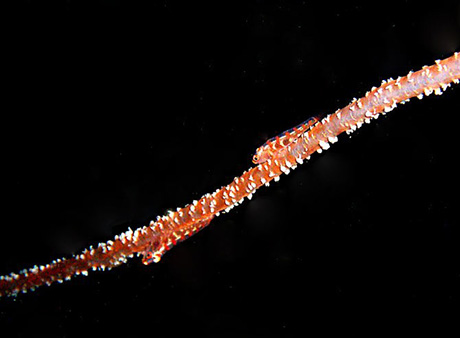
A male-female pair of gobies, beautifully camouflaged on wire coral. Malapascua, Cebu Island in the Philippines. Graham Collins
These hexacorals play important ecological roles as habitat providers. They host many symbiotic species, which spend their adult life with their host and use them to access food. The small fish and shrimps feed from the water passing over the black corals; the same conditions suit both.

Whip Coral Goby (Bryaninops yongei) on a White Whip Coral. Anilao, Philippines. Daniel Lamborn/DepositPhotos
Prefer fast moving water
The yellow wire coral prefers current rich areas, often sticking out at right angles to a coral wall. The moving water brings the plankton upon which they feed. Unlike many corals found in shallow water, they don't have photosynthesising zooxanthellae in their tissues and get all their nutrition from filter-feeding.

Wire coral in the Maldives. Tim Nicholson
Male and Female
There are male and female wire corals, each wire or whip being a colony of polyps. They spawn annually towards the end of summer, when sea water temperature rises, releasing their eggs or sperm through the mouths of the polyps.

The Anker's Whip Coral Shrimp. Also known as the Barred Wire Coral Shrimp. Taken using fluorescence photography while diving in Tulamben, Bali. Kim Briers
Hope for the Future
Though named for their jet-black skeletons, the vibrant wire corals host many other species. Next time you see one underwater look closely for them - they make great underwater photography subjects. The yellow wire coral's remarkable resilience fast growth rate and heat tolerance means with conservation efforts they can quickly recover from over-harvesting.
References
Godefroid M. et al (2021), Perspectives on working underwater with black coral nubbins (Cnidaria: Antipatharia): The case of Cirrhipathes anguina (Dana, 1846), Journal of Experimental Marine Biology and Ecology, Vol 545, https://doi.org/10.1016/j.jembe.2021.151645.
Terrana, L. et al (2019). Assessing trophic relationships between shallow-water black corals (Antipatharia) and their symbionts using stable isotopes. Belgian Journal of Zoology, 149. https://doi.org/10.26496/bjz.2019.33
Bo M, et al. Growth strategies of whip black corals (Cnidaria: Antipatharia) in the Bunaken Marine Park (Celebes Sea, Indonesia). Marine Biodiversity Records. 2009;2:e54. doi:10.1017/S1755267209000712
Why black corals aren't black (and 7 other surprising facts). SCUBA News, 28 September 2025
Diving news from around the World
|
|
Where to dive with manta rays
|

|
|
Dinner table deception: deliberately mislabelled endangered sharks being sold in US stores
|

|
|
Nearly 80% of whale sharks in this marine tourism hotspot have scars caused by people
|

|
|
Are farmed oysters, mussels and clams the ultimate green foods?
|
|
|
Public strongly backs aim of 30% of land and sea set aside for nature, poll finds
|

|
|
Why are manatees starving and what can we do to help?
|

|
|
Resilient corals survive warming seas, but don't thrive
|

|
|
What climate change means for the Mediterranean Sea
|
|
|
Octopuses dream when asleep
|

|
|
Study shows all octopus arms can do everything
|

|
|
Tracking right whales the right way... by thinking small
|

|
|
Maldives U-turn: shark fishing allowed again
|

|
|
Solo Scuba Divers - Liveaboards without single supplements
|

SCUBA News is licensed under a Creative Commons Attribution 4.0 Unported License. This means we are happy for you to reuse our material for both commercial and non-commercial use as long as you: credit the name of the author, link back to the SCUBA Travel website and say if you have made any changes. Most photos though, are copyright the photographer. Please get in touch for details.
Photo credits: Tim Nicholson, Jill Studholme, Ryburn et al/CC BY 4.0, Kim Briers, Carol Buchanan/DepositPhotos, divebooker.com
UNSUBSCRIBING
Visit {?$optout_link?} to remove yourself from the mailing list. Any problems
contact [email protected].
ADVERTISING
Should you wish to advertise in SCUBA News, please
see the special offers at
https://www.scubatravel.co.uk/newsad.html
Other advertising opportunities are at
https://www.scubatravel.co.uk/diving-advertising.html
CONTACTING THE EDITOR
Please send your letters or press releases to:
Jill Studholme
SCUBA News
The Cliff
DE6 2HR
UK
[email protected]
SCUBA News (ISSN 1476-8011)
Every month we send out a free newsletter featuring the best diving areas, underwater life, diving book reviews and interviews with authors. To receive this please fill in your e-mail address below. For an archive of previous issues see the SCUBA News page.