2 April 2024
Around 1000 species of fish live in the Red Sea, and 150 species of coral. Click the photo for an enlargement and more details of that animal.
Fish • Mammals • Turtles • Coral • Featherstars • Flatworms & Nudibranchs • Cuttlefish & Octopus • Sponges
Sharks • Rays • Eels • Scorpionfish & Stonefish • Crocodilefish • Clownfish • Grouper • Triggerfish • Squirrelfish • Pufferfish • Butterflyfish • Angelfish • Spadefish • Pufferfish • Butterflyfish • Angelfish • Batfish • Trevallies • Gobies • Others
Find a last-minute Red Sea liveaboard deal!
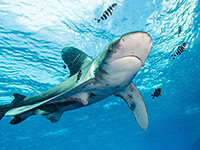
Photo: Alexander Vasenin
(CC BY-SA 4.0)
The glorious oceanic whitetip sharks spend a lot of time in shallow water, tend to swim slowly and are very curious. All of these mean that divers can get superb closeup view of them. They are easy to distinguish from the reef whitetip by their more substantial bodies, the pilot fish that continually accompany them and their rounded fins. A beautiful and awe-inspiring shark. If you should see an oceanic whitetip, keep calm, keep facing it and move very slowly. Treat it with respect as it can be dangerous. Oceanic whitetips used to be the most common pelagic shark in the sea, but now they are critically endangered. The besst places to encounter them in the Red Sea is at Elphinstone reef.
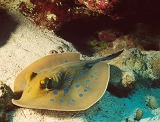
The Dasyatidae family contains about 100 species, one of which is the Blue Spotted Stingray. Like all stingrays they have venomous spines at the base of the tail. They breathe by drawing water through a small hole behind the eye and expelling it through gill slits on their undersides. They often lie on sandy bottoms, flicking sand over themselves as camouflage. They feed on molluscs and crabs. Common and easy-to-spot throughout the Indian and Pacific Oceans, including the Red Sea and the Great Barrier Reef. Simple to identify with their oval shape and blue spots. Not aggressive, but if you accidentally step on one the spine may be driven into your leg. This causes intense pain, increasing for around 90 minutes and lasting, if untreated, for 1 to 2 days.
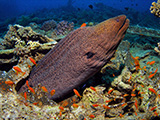
The largest of the moray eels, growing up to 3 m. Quite common and always interesting to observe. Feeds primarily on fish, occasionally on crustaceans and octopus. Morays live in holes and generally hunt by night. You may see them rhythmically opening and closing their mouths. They do this to maintain a respiratory current past the gills. Morays undergo a sex change during growth, changing from male to female.
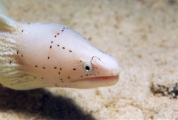
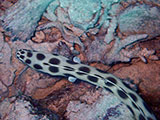
If you see what you think is sea snake in the Red Sea it is actually a snake eel, as there are no sea snakes here. The snake eels are an interesting group, seen much less frequently than the morays. Spotted snake eels around the world mimic venomous sea snakes, but the subject of its mimicry is kept out of our spotted sea snake's habitat by the, it is thought, the high salinity of the Red Sea.
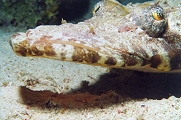
Mainly lives on sand and rubble near coral heads, although you might also find it in patches of seagrass. It stays shallow: between 1 and 15 m. The flatheads are flattened fishes. They have two dorsal fins and bony ridges and spines on their heads. The body is mottled above, whitish below. The Carpet Flathead grows to 70 cm. It is a very placid fish which, confident in its camouflage, lets you approach closely. Although related to scorpion fish it is harmless.

The scorpionfish is one of the most venomous fish in the world. It has several spines linked to venom glands. The poison causes severe pain and paralysis. The scorpionfish is extermely well-camouflaged. It can change colour to match its background and has many "tassles" masking its outline. This Tassled Scorpionfish lives from 1 to at least 35 m in the Red Sea and Indo-Pacific. Lacking a swim bladder, it remains on or near the bottom. Lethargically, the fish waits for prey to pass by then opens its lower jaw and sucks its victim in. Not many animals prey on the scorpionfish, its venom deterring most. A fully grown octopus though does not seem to be affected by the spines and will envelop and eat the scorpionfish.

Found in the Red Sea and Indian Ocean to the Andaman Sea. Usually 11 dorsal rays (those on the top of the fish). A sting from this fish can be very painful, and possibly fatal. They often shelter under ledges during the day, being more active at dusk and during the night when feed on fishes and crustaceans using their non-stinging pectoral fins to shepherd prey into their mouths.
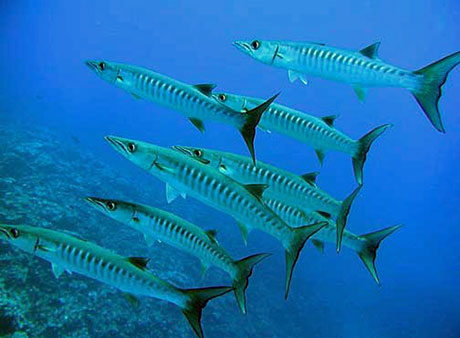
The Great barracuda is a top predator and uses very highly developed smell and vision senses to locate its prey. When attacking, the barracuda will charge at fast speed (approximately 12 ms-1) and ram their target. They then unleash the power of their jaws which allows them to slice through their prey, even those larger than the barracuda itself.
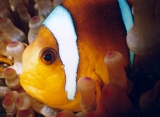
The most common clownfish in the Red Sea, hence its name. But it doesn't just live in the Red Sea. You will also find it in the Gulf of Aden and in the Chagos Islands in the Pacific some 3364 km away. But curiously nowhere in between. Clownfish start off male, but if the female dies the dominant male will change into a female. The Red Sea Clownfish lives from the shallows down to 30 m, generally living in pairs in association with an anemeone. The tentacles of the anemone protect the clownfish from predators. At first contact with the anenome the clownfish jerks back, but gradually its mucus coating gives it immunity to the anemone's stinging nematocysts.
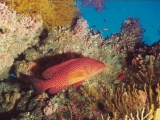
Found around coral in areas with clear water. Easy to spot and fairly common. Range from 2 to 150 m and feed mostly on fish. Grow to around 41 cm. Has a large mouth and sharp teeth. Groupers are the most important family of reef based predators. Territorial and solitary apart from in the mating season in June.
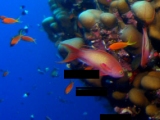
Also known as a Jewel Fairy Basslet, this are the most common species of Anthias found in the Red Sea. The male and female are different colours. The bright orange, smaller fish are the females; pinky-yellow coloured fish the males. You see them in large groups clustered around coral outcrops. All fish start off life as females. Where a male is lacking, the dominant female fish will turn into a male. The males are territorial and keep a harem of female fish.
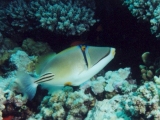
Trigger fishes are so called because of the shark-fin shaped trigger they are able to raise in defence. They use this to jam themselves into a crevice in the coral. The trigger is actually the first spine of its dorsal (top) fin. They bend the second spine forward to fix the first firmly in position. When the fish is swimming the fin is flattened into a groove.
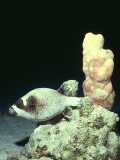
Distinctive looking, this small pufferfish has a black mask over its eyes and a black mouth. It is common on fringing coral reefs in the Red Sea. They are called pufferfish because when threatened they greatly inflate themselves with water, making themselves look much larger than they usually are. This defence mechanism is important because they move so slowly through the water they would otherwise be easy pickings for predators. Their second line of defence is their toxicity. The Puffer's toxin - tetrodotoxin - is produced within the pufferfish by bacteria. Weight-for-weight, tetrodotoxin is up to 100 times as deadly as the venom of the black widow spider and one of the most poisonous natural substances.
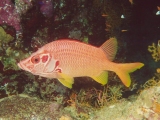
This species is the largest of the squirrelfish. It's common in the Red Sea at all depths likely to be dived. Squirrelfish have large eyes and are nocturnal. During the day you'll find them under ledges and in caves, away from the light. Growing up to 45 cm, they live alone or in small groups. You can distinguish Sargocentron spiniferum from other squirrel fish by the red blotch behind its eye. To us this red fish is easy to spot during the day, but to other fish it blends into its dark crevice or cave. Long red light wavelengths don't penetrate water well, so fish colour vision tends to be tuned to the shorter, blue and ultra-violet, end of the spectrum. This means that red and pink fish are inconspicuous.
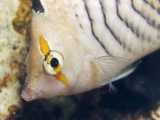
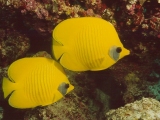
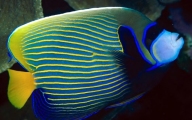
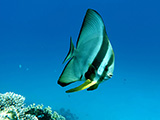
These slow moving fish are not at all intimidated by divers, and often come to greet you on your dive. Three species live in the Red Sea longfin spadefish (Platax teira), circular spadefish (P. orbicularis) and golden spadefish (P. boersii). Previously spadefish were known as batfish, and many divers, myself included, still routinely call them this. They all have thin deep bodies. Other features they have in common are their greyish colouring and the two black or grey stripes going vertically down their bodies, one through the eye and the other at the back of the head. The juveniles look different to the adults.

Trevallys are large silvery fishes with forked tails. They are fast-swiming predators of the waters above the reef and in the open sea. The Bluefin Trevally is distinctively coloured, being the only trevally with electric blue fins and blue speckles on a gold or green background. This fish can be as large as 1 metre, but you normally see individuals smaller than this. They range from the shallows to the depths, usually singly but you may see a trevally small school.

Young Golden Trevally are strikingly coloured, their gold and black striped garb showing from where their name comes. These young fish like to seek out large animals like sharks, groupers and dugongs for protection, acting as pilot fish. Sometimes they make a mistake and decide that a diver is the perfect companion.
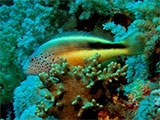
Seen from 1 to 33 m resting motionless on coral. It is carnivorous, feeding on crustaceans and small fish. A member of the Cirrhitidae family, it can change sex. Young fish are all female. One male has a harem of females - if the male dies one of the females changes sex to take its place. Males are very territorial.

Sweetlips have thick lips, continuous dorsal fins and truncate or emarginate tails. Adults are often inactive during the day and shelter near or under ledges. They feed at night on bottom-dwelling invertebrates. The juveniles of Blackspotted sweetlips have 6 black lines on their heads and bodies, these become spots with age.
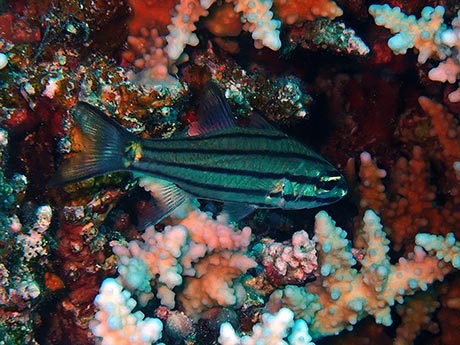
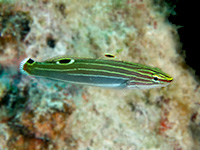
Previously thought to be the same species as the Hector's goby, Hoesei's Goby was only recognised in 2018 (Marcelo Kovacic et al). Found in the Red Sea and Gulf of Aden, Hoesei's goby is small, growing to just 6.5 cm (2.5 inches). You'll find it hovering above the bottom amongst coral rubble or patchy reefs.
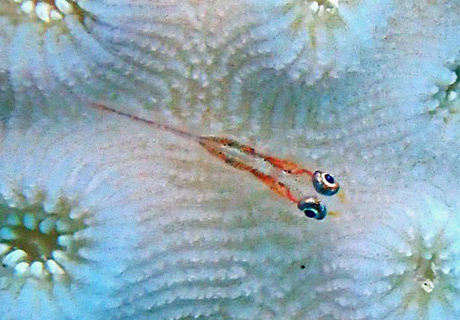
If you look carefully at this semi-translucent little fish you can see its organs. The ghost goby lives mainly on stony corals to around 30 m. Its red fluorescent eyes probably helps them forage for their preferred food of miniscule crustaceans (red fluorescence enhances visual contrast at depths below 10 m).
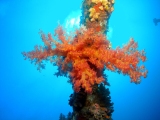
This species is common in the Red Sea and a pioneer settler. It can clone small fragments of itself with root-like processes that let them quickly attach to artificial structures like wrecks. Especially vertical structures. (Our photo was taken on the wreck of the Carnatic.) One of the Nephtheidae family, the soft coral takes in sea water to expand its body before feeding. This builds up a positive pressure inside the coral that supports the branches and trunk. Unlike most other corals, D. hemprichi don't depend on symbiotic algae: they are azooxanthellate (asymbiotic). Instead they feed almost exclusively on phytoplankton.
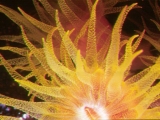
Tubastraea lack symbiotic algae and do not contribute to reef building. They tend to grow on underhangs, drop-offs and reef slopes in strong currents. The name combmes from the Latin for tube (tubus) and the Greek for star (sastron). At night the coral skeleton (corallum) is hidden by a ring of bright yellow tentacles, as shown in the photo above. During the day the tentacles are retracted into deep circular calices. The skeletal tubes measure 5-15 mm across and protrude by 10 mm or more from the coral surface. Cup coral is also known as sun coral.
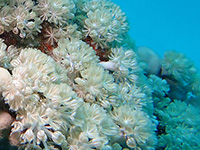
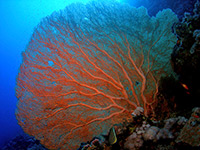
A gorgonia. Growing at right angles to the prevaling current, their tentacles strain microscopic particles of food from the water. When currents threaten to damage a colony, they can bend and then spring back into their original position. The giant sea fans take 10 to 15 years to reach their maxium size. Sea fans are actually colonies of many small individual polyps connected together to form a lacey sheet.
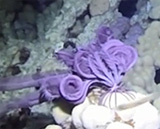
Feather stars, or crinoids, are so called because their arms look just like feathers. By day they keep curled up but on night-dives you see these pretty animals in their warm colours, with their feathery arms extended. When food is plentiful, with strong currents carrying large amounts of plankton, feather stars will form large groups. They appear to have no particular predators. Look closely and you will often see another animal - such as a shrimp, crab or fish - living with the feather star.
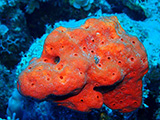
It's called the boring sponge as it drills into coral and sea shells. The sponge breaks down dead and diseased (and sometimes live) coral. It extends thread-like etching cells into its host and chips off bits of calcium carbonate, expelling them through its pores. Over time the sponges create little tunnels beneath them.
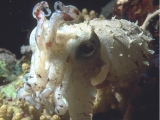
Just few centimeters long, this is a kind of nudibranch which looks dark red in natural light or dark blue if you shine a torch on it. It has two yellow head lobes which look just like sticky-out eyes. Only found in the Red Sea. Common names include Red Sea Chelidonura and Yellow Lip Shield Slug. Part of the Aglajiidae familiy.
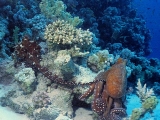
The octopus is solitary. Mating can be risky for the male: he is smaller than the female and risks being attacked. The female watches his body postures and skin pattern. Once accepted the male stretches out a modified arm towards the female - shown in our photo. The arm has grooves along which sperm passes to the female's mantle cavity.
By Jill Studholme,
Photos: Tim Nicholson, Jill Studholme, DepositPhotos
This page is regularly updated. Our newsletter, SCUBA News (ISSN 1476-8011), will let you know when. To receive your copy fill in your details below. We will not pass your e-mail address to any third parties, or send you unsolicited e-mail.