The Scuba Diving • Dive Centres • Abu Dabab • Where to Stay • Further Reading • Leave a Comment • Rest of the Red Sea
3 October 2023
Two divers give the low-down on the scuba diving around Marsa Alam in the Red Sea: Dugongs, Dolphins, Sharks and Turtles by Graham Collins; Wow," I said to Anna, "I didn't expect this by Greg Kruse. Also, recommended dive operators and liveaboards. Photo credits: David Collins, Greg Kruse, Suzanne Challoner, Javier Grinfeld.
This Marsa Alam video features turtles, dolphins, sharks and stonefish. Starts with a green turtle (Chelonia mydas) eating seagrass and accompanied by a sharksuker (Echeneis naucrates). Progresses to guitar shark (Rhinobatus halavi) and trumpet fish (Fistularia commersonii). Spinner dolphins (Stenella longirostris) put in several appearances. The confusingly-named zebra shark (Stegostoma varium) shows off its spots (the juveniles have black and white stripes). Compiled from original footage by David Collins.
Egypt Divers 5 star diving center SSI & PADI is based in Marsa Alamproviding all diving programs, snorkeling and water sports activities.
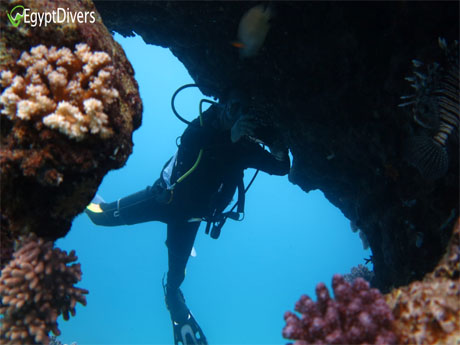
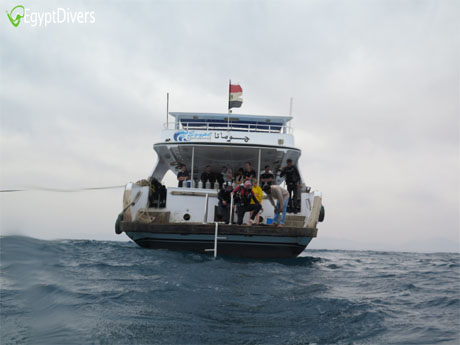
Diving packages and diving courses are our profession and passion - tailored to make your holiday fun like never before. Introducing you to the ultimate experience in boat or shore dives, our professional instructors are ready to share all their knowledge and experience with you. Our instructors speak English, German, Russian and French.
Tia Heights
Makadi Bay
Egypt
Tel/WhatsApp: +20119599593
info@egyptdivers.com
egyptdivers.com
"Marvellous experience, nice team. Thanks Egypt Divers for showing my wife how to dive and thanks for convincing her to go diving finally. Good boat, delicious food. definitely diving again with you guys next holiday."
Inn Shapiro, 19 March 2018
Dugongs, Dolphins, Sharks and Turtles
by Graham Collins
Abu Dabab, at Marsa Alam, used to be the haunt of the dugong, but the building of 3 hotels has meant that they are now more scarce. Our first dive here followed the north side of the bay along the reef. This is an interesting dive and we saw 4 large remora on their own (without a host). A second dive went out into the sea grass area and saw several guitar sharks and 3 large green turtles which were untroubled by our presence and gave good photographic opportunities.
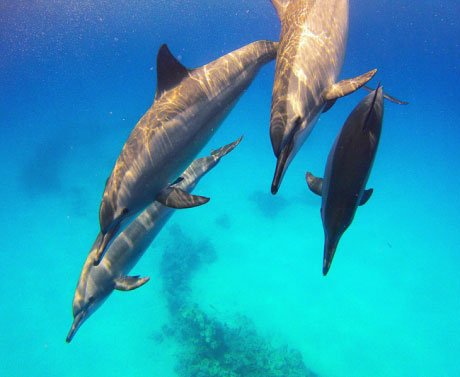
Dolphin House Reef has been designated a protected area, to protect the shallow bay where the dolphin sleep. A day boat is used to reach this site, and attracts snorkellers who swim with the dolphins when they leave their protected area, as well as divers. We were dropped off from the boat as it reached the horseshoe shaped reef, and we made a drift dive along the reef to where the boat anchored. There are lots of soft corals, and a turtle lunching on soft coral, which made for an excellent dive. Following lunch on the boat we took the opportunity to snorkel with the several dolphin pods which were clearly happy to interact with the snorkellers.
Later we dived through The Canyon which makes a beautiful scenic dive from the boat anchorage and round the coral pinnacles in the area.
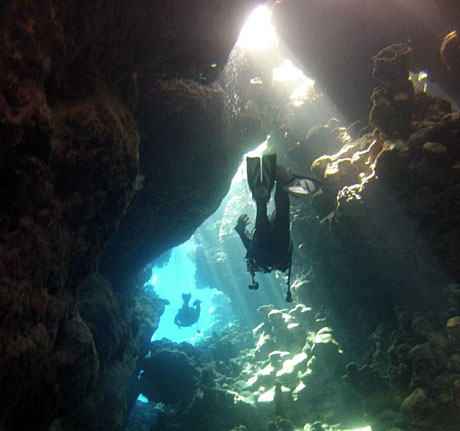
Although many of the bays around Marsa Alam have been developed with resorts and hotels, a few have been protected and make good shore dives. We dived at Marsa Al Salya. This involves quite a long walk out across the reef, and then we searched the sea grass area, without great success, so then we followed the north side of the reef for a pleasant dive. To the north is Marsa Eglet, where we found several turtles feeding on the sea grass.
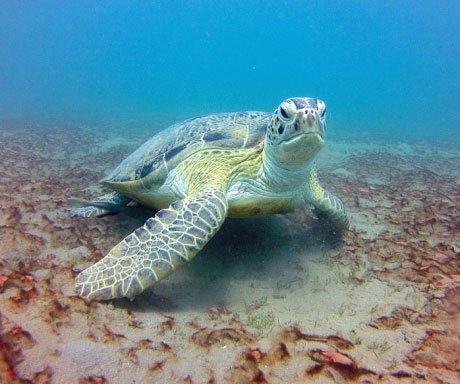
Green Turtle (Chelonia mydas) at Marsa Eglet
Out on the north reef there is a beautiful coral block with shoals of glass fish and lots of other life. On the way back there was a very large moray eel.
The Solitaire House Reef
We did two dives on the house reef of the resort to check it out. The entry is a jump off the jetty which goes out over the reef. On the first dive we went north along the drop-off. This was typical house reef scenery and fish life, and because of the limited diving over the last few years had good coral growth. There was a full sized Napoleon wrasse on the way back.
In the afternoon we went south along the house reef, where the drop off is steeper and there are even more corals. A silhouette at the bottom of the drop off turned out to be a zebra shark resting, and we were able to get good close up views before it moved off. There were also scorpion fish, a moray eel and sting rays.
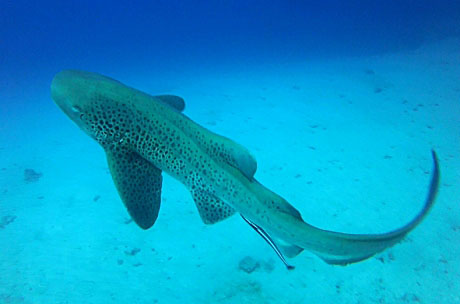
Zebra shark, Stegostoma varium
As the season changes from winter to spring, there can be strong winds along the red sea coast. We tried a dive at Marsa Samedi, but it was a bit like a washing machine in the bay, so our last day was spent playing water polo with the other guests in the resort pool.
"Water, water, everywhere,/ nor any drop to drink..." lamented the Ancient Mariner in Coleridge's famous poem. The sea, too, can be a desert, with its vast, flat, empty surface sparkling and bare under the sun. And so it felt, driving 250 kilometers south from Hurghada toward Marsa Alam along the Red Sea coast. The Great Eastern Desert to the right of us and the Red Sea desert to the left of us and the long black line of the road ahead.
"Wow," I said to Anna, "I didn't expect this."
"I thought you would be shocked," she replied. "It's not at all like the tropical islands we're used to."
The unexpected desolation was accentuated by dozens of unfinished hotel construction projects scattered along the roadside. Bare concrete block walls, dusty courtyards, and a few frazzled palm trees seemed to be the extent of more than half of the projects waiting, unfinished, for a brighter day.
We booked at the Oasis Dive Resort just north of Marsa Alam. It sits on a bare rocky cliff overlooking the beach, the simple buildings done in traditional village architecture befitting the environment. A cluster of palm trees and aloes, and a small grove of stunted olive trees in the wadi running through the property help to create the feeling of an oasis in the desert. On the beach side, a pier juts out into the sea, reaching the dark line where bright shallow water suddenly turns dark and deep.
All activities at the Oasis turn around the dive shop. Racks of gear and shelves of books and detailed maps of local dive sites all over the wall confirm that this is a serious and well-organized operation, part of the Werner Lau system that extends through the Maldives and on to Bali. Although boat diving is offered, we opted for shore diving. It's simple and easy, and you don't get mal de mer. A fifteen to thirty minute minivan ride gets you to one of the many little bays that line the coast - marsa means bay. You gear up on the shore, wade in, and off you go.
Diving the Red Sea is different from other oceans. Reefs run the entire length of the coast, but the bays are shallow, making buoyancy control challenging, and the Red Sea is about 15% saltier than most oceans, so we had to add about 3 kilos of weight over what we would normally carry.
The extra weight adds a further dimension to the already strenuous task of walking down to the water from where you gear up on the beach. Tank, weights, buoyancy control vest, fins, mask and snorkel, camera; we struggled along feeling like astronauts, wearing all our gear down to the water's edge. Once we were under water, the dives were bliss. Because the bays are so shallow, 70 minute dives are common. Free nitrox at the Oasis makes long dives even easier and less fatiguing.
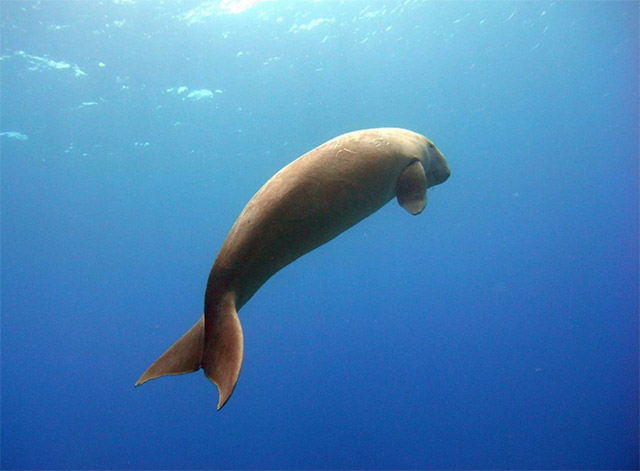
The typical site is a bay with seagrass beds in the middle and coral gardens and walls on both sides. A common dive plan is to head out into the seagrass beds at first, where most life is encountered only 6 to 10 meters down, to go looking for turtles and rays and guitar sharks, and also for It, the creature whose name must not be said, or you will never see it. Dugongs were once common in these bays, but their numbers have greatly reduced recently as tourism grows. Giant sea turtles more than a meter long, however, can be found grazing in herds like cows in the seagrass beds. We never did see It.
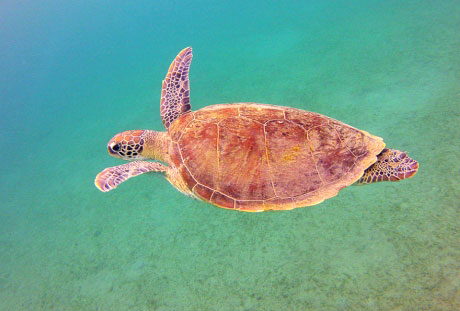
After 20 minutes floating over the seagrass, we would head to the north shore coral gardens, which are generally richer than those on the south side of the bays. There is a great variety of hard and soft corals, reef fish of all kinds, lion fish, scorpion and crocodile fish, as well as morays and octopuses, cuttlefish and squid. The sea floor drops fairly rapidly toward the mouth of the bays, providing richly colorful walls to explore for down to 20 meters and more. Going out fairly deep, but rising up to 10 meters or less on the return extends dive time and gives you a chance to find some of the Red Sea's odder creatures.
On one such return, at Marsa Egla, I saw Anna hanging about 5 meters from the bottom a little off the wall, staring intently at the sea floor. She looked over at me, and pointed down at something. Henry, who had buddied with us that day, and I drifted over to see what she had found. Below us, something that looked like a rock was crawling across the sand among the coral heads. We all went down to take a closer look. It was hard to say what it was. It clawed slowly across the sand on insect-like black legs, and was more perfectly camouflaged than a scorpion fish. It was difficult to spot its eyes, or even to determine whether it was a fish. Henry took several photos, looking back up at me in amazement between shots as if to say, "What is this thing?"
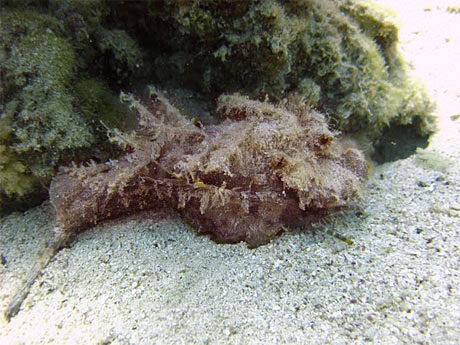
Red Sea Walkman, Inimicus didactylus
We puzzled over it after the dive on the way back to the Oasis. I recalled having read about some kind of fish that crawls in the Red Sea. When we got back, I asked Roland, one of the divemasters, what it could be.
"Oh, that's a Red Sea Walkman," he replied at once, "very funny looking fish, and as toxic as a scorpion. It's sometimes called a devil fish. Nasty fellow, don't mess with him!"
Henry grinned. "Is that by Sony?" he asked.
But Roland was serious, and so it was. Anna had found a Red Sea Walkman (Inimicus filamentosus). That was the highlight of a series of very excellent dives, with a wonderful variety of marine creatures. The best dive site was Abu Dabab, where a herd of sea turtles grazed the sea grass beds, octopi were hiding among the corals, a cuttlefish sat tranquilly on the sand, and a squadron of squid wheeled with perfect symmetry to eye us as we passed below. Roland gently scratched an octopus between the eyes as it sat on a coral head trying to look like a rock. He was doing a pretty good imitation, but each time Roland would scratch him, he would recoil slightly and turn from mottled black and brown to pure white. He stayed put for several scratches, and we left him there when we sailed on.
Be warned, however. Even Marsa Alam is rapidly becoming overcrowded like the Red Sea dive sites further north. At one point, returning from our last dive at Abu Dabab, where we had set out almost at sunrise, we ran into a crowd of about fifteen divers coming toward us around a point. Looking up, the sea was frothy with a score of floundering snorkelers. Before long, even It will be only a memory of quieter times, so plan your visit soon.
By Greg Kruse, Leave a Comment
For Elphinstone see Elphinstone Dive Sites.
Abu Dabab is famous for its sea grass beds - home to green turtles and guitar sharks. You might also see Dugongs there.
"In one of the Red Sea safaris we stopped in a small bay near Wadi Abu Dabbab, north of Marsa Alam. The bay was quite ugly as a dive site per se- a relatively small sandy patch maybe 100x100 meters devoid of coral reefs or almost anything, covered with sea grass and lots of junk.
Almost.
Because the charm of this sandy bay is the green turtle population that reside there, living in company of some pretty honeycomb sting rays (and rumours have it there are dugongs living there too, but can't confirm).
So, into the water we went, and not more than few minutes into the dive see a huge rock covered with large remoras. Then the rock majestically starts moving, looks at us and goes on its business of munching grass. By Neptune, these turtles are big!
I can't estimate how many turtles reside there, we met something like a half a dozen different ones.
A pity they are endangered..."
Javier Grinfeld
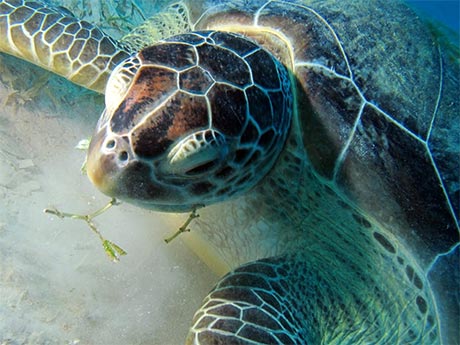
Photo credit Javier Grinfeld
"Abu Dabab, at Marsa Alam, used to be the haunt of the dugong, but the building of 3 hotels has meant the bay is now too busy. Also the sea grass area has been badly damaged by the washing of sand into the bay following a rainstorm: the sea grass has been replaced by a brown algal growth on the sand. Our first dive here followed the north side of the bay along the reef. This is an interesting dive and we saw 4 large remora on their own (without a host). A second dive went out into the sea grass area and saw several guitar sharks and 3 large turtles which were untroubled by our presence and gave good photographic opportunities."
Graham Collins, UK, 2013
"Dugongs, Guitar Sharks and Giant Turtles are just a few of the amazing creatures you can see swarming the Sea Grass area in Abu-Dabab.
"
Yaseen Abdel-Ghaffar, USA
"Both sea grass beds and coral gardens were rich in large and small marine life. Huge turtles grazed the seagrass beds, while many octopus, cuttlefish and squid were found along the north shore in the coral gardens. Go very early in the day, the bay becomes a madhouse later when all the tour groups arrive.
"
Greg Kruse
"Dolphin House Reef has been designated a protected area, to protect the shallow bay where the dolphin sleep. A day boat is used to reach this site, and attracts snorkellers who swim with the dolphins when they leave their protected area, as well as divers. We were dropped off from the boat as it reached the horseshoe shaped reef, and we made a drift dive along the reef to where the boat anchored. There are lots of soft corals, and a turtle lunching on soft coral, which made for an excellent dive. Following lunch on the boat we took the opportunity to snorkel with the several dolphin pods which were clearly happy to interact with the snorkellers.
"
Graham Collins
North of Marsa Alam.
"El Quadim Bay, El Quseir, should definitely not be missed on the (top 100 dives) list. It is an absolute treasure.
"
Anon, 2015
Egypt Divers 5 star diving center SSI & PADI is based in Marsa Alamproviding all diving programs, snorkeling and water sports activities.
Diving packages and diving courses are our profession and passion - tailored to make your holiday fun like never before. Introducing you to the ultimate experience in boat or shore dives, our professional instructors are ready to share all their knowledge and experience with you. Our instructors speak English, German, Russian and French.
Tia Heights
Makadi Bay
Egypt
Tel/WhatsApp: +20119599593
info@egyptdivers.com
egyptdivers.com
"Marvellous experience, nice team. Thanks Egypt Divers for showing my wife how to dive and thanks for convincing her to go diving finally. Good boat, delicious food. definitely diving again with you guys next holiday."
Inn Shapiro, 19 March 2018
Angie and Youssef, English and German speaking PADI Dive Instructor and Divemaster, working independently in Egypt. They are based in El Quseir and offer diving between Hurghada and Marsa Alam. Only dive in small groups and in a relaxed atmosphere. Provide liveaboard or daily boat diving from Hurghada. Happy to organise your accommodation close to the dive sites.
El Quseir
E-mail: angieseamisstress@gmail.com
Marina Lodge
Port Ghalib
Tel: +20 12 7372126
E-mail: marsa.alam@emperordivers.com
Book diving via Divebooker…
68 Street
Qesm Marsa Alam
Marsa Alam
Red Sea
Tel/whatsapp : +201002080697
Tel: +201002080697
E-mail: info@MarsaDiving.com
16 Gildredge Road
Eastbourne
East Sussex
BN21 4RL
United Kingdom
Tel: 0044 (0)1323 648924
E-mail: info@oonasdivers.com
Marsa Shagra
Tel:+20-195-100 262
E-mail: info@redsea-divingsafari.com
Marsa Alam
Tel: +20 100 5052855
gm@oasis-marsaalam.com
"The Oasis Dive Center, at Oasis Dive Resort, offers both shore and boat diving (Elphinstone, Samadai Reef), free nitrox. Experienced divers can go on their own when shore diving or follow the group. Orientation to shore diving sites was excellent, with detailed hand drawn maps of each site showing landmarks and suggesting routes. Divemasters were all friendly, cheerful, and very experienced. Will go again and recommend to friends. Very Good. Good food, very professional dive shop and dive masters, very well organized, good equipment, free nitrox."
Greg Kruse
Hilton Nubia
Abu Dabbab
Marsa Alam
Tel: +20 12 0753 5555
E-mail: dev@blueocean-eg.com
For people with partners or children who don't dive the Kahramana hotel is a good choice. This is a sprawl of small buildings, each one comprising two or four rooms (a room being a large bedroom, bathroom and hallway). There is plenty to do: horse and camel riding, beach volleyball, tennis courts, two swimming pools, two beaches and a children's playground.
As you will not be near a town, paying a little extra for a hotel with three restaurants plus bars and bar-snacks is definitely worth it. They've managed to convert the desert into a garden with a huge array of gardeners keeping the plants healthy. Palm trees have been planted on the beaches and the buildings are the same red and ochre as the desert sand.
Al Qusair
Marsa Alam
"Oasis Dive Resort, Marsa Alam is a good place for divers, excellent dive shop, well organized shore diving all along the coast near Marsa Alam, house reef is OK, you can walk down to the pier and hop in to the Red Sea."
Greg Kruse
Recommend a dive or dive centre...
Or jump to Europe, Africa, Pacific, Asia, Americas, Caribbean, Elsewhere...