
Reviews: "Love the newsletters! Keep them coming" Janice Fleming...MORE REVIEWS

12 June 2023
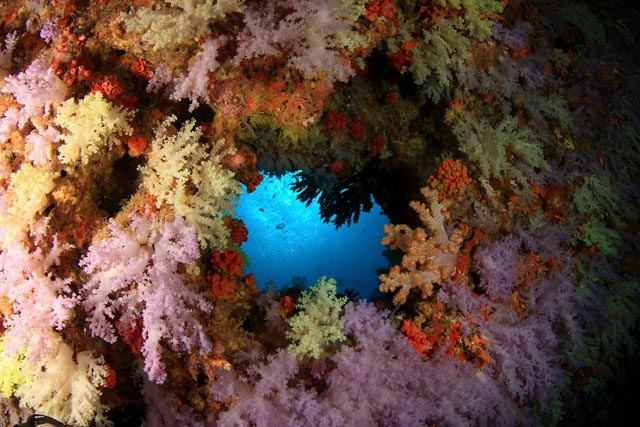
The diving in Papua New Guinea is spectacular - with waters jam-packed full of fish. Expect walls, reefs and wrecks. To protect the reefs, the Papua New Guinea Divers Association (PNGDA) are installing permanent moorings on regularly dived sites. Dive operators that are members of the PNGDA have a strict 'look but don't touch' policy.
Papua New Guinea Liveaboards - Compare prices online. Book now & pay later.
Papua New Guinea, or PNG for short, is an independent state located to the east of the island of New Guinea (the west is Irian Jaya, also known as West Papua, which is part of Indonesia). It is in the area known as Melanesia - north of Australia. Part of the Commonwealth, it is one of the most rural countries in the world.

As well as the mainland, Papua New Guinea has around 600 islands. Of these, New Britain, New Ireland and Bougainville are the largest.
Diving is possible all year round, but the best time to go is from from mid-April to mid-June and mid-September to mid-December. Water temperature ranges from 26oC to 31oC.
 >
>
There is a recompression chamber at Port Moresby run by Hyperbaric Health Australia .
Most visits to Papua New Guinea are trouble free, but there is a high level of crime in the urban areas. Don't forget to get travel insurance before you go. Be aware though that homosexuality is illegal.
You will need a visa to visit, which is free on arrival. To check current visa regulations visit the PNG Immigration & Citizenship Service Authority site. Flights go from Singapore.
Dive Sites • Dive Resorts and Liveaboards • Further Reading • Comments
I have lived in New Guinea for 15 years. 3 of those years I have spent diving in the waters around New Guinea, in the that short time I have seen 5 major ship wrecks, 7 WWII bombers fully intact and enough coral and wildlife to fill up the continent of Asia.
Most diving operators are PADI and Australian. There are all sorts of marine life ranging from clown fish to tiger sharks. I went to a dive sight called coral head, there where sharks everywhere, at one point I saw six at once, they came with in ten feet of me, most are harmless and are reef sharks, but there was a shark that circled me, it looked about 7 feet.
There are wrecks from all over the world in New Guinea. One ship I dived was 32 meters under, but the mast was only 5 meters below the surface. It was a cargo ship from WWII it was about 45 meters long. There are many places around New Guinea and the Solomon Islands that are excellent for seeing blob-headed clown fish, schools of 400 barracuda, sea turtles, sharks: the fish come in ever colour in the world.
No joke. Despite what rumours you have heard
about New Guinea, it is really a friendly and secure place if you go to
the scuba places. There are a few that I will name for you, Coral Sea's
Resort, Kevieng (New Ireland Province), Jasoben, Madang (Madang
Provence), Hoskins (West new Britain).
Nick
Murray
"There is one dive that I
did called The Gates...two massive coral pillars that form the sides of
a long wall underwater. When the tide goes out all the water is sucked
through the gates which are forty metres high, when the tide comes back
in all the sea life comes to feed on the plankton, and then the larger
predators come to feed on the sea life it is an awesome sight. If I were
to count the sea life individually, I would say, at the Gates, there was
about fifty million fish."
Nick Murray
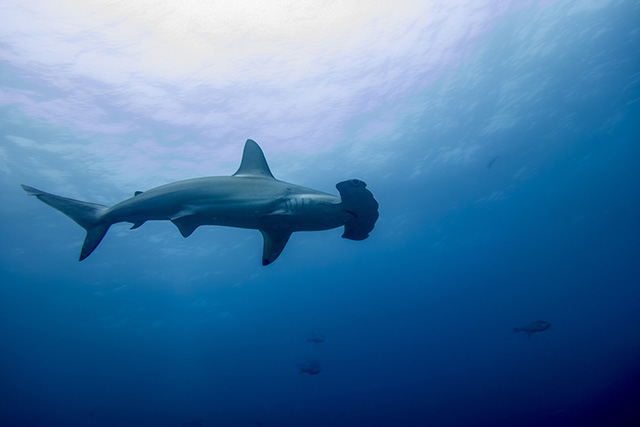
"Many hammerheads, silver tip sharks, whale sharks, bait ball etc. schooling jacks etc.
Scubajack
"Unbelievable fish life, especially on a current."
Jennifer Dachroeden
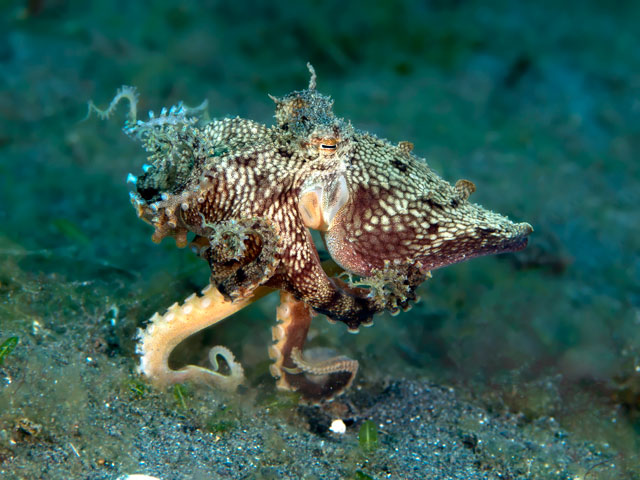
"Great for small critters. Mimic octopus, pegasus moth fish, seahorses, etc."
Jennifer Dachroeden
"This is a great
and relatively shallow drift dive - around 23 m. When the current is
running, this attracts lots of sharks, from white and black tipped reef
sharks to the bulkier grey reef sharks. You have to be careful not to
get swept down the passage, which would be a bit annoying, but there is
a permanent mooring line to latch on to when ascending and doing safety
stops. This really is a shark divers dream - I was totally"sharked out"
after three dives here."
Iona Hill
"A real
adrenaline dive. You can get 2 dives in one, depending on how vicious
the current is and so where you jump in: there is a ship wreck at the
edge of a finger shaped piece of coral. You can descend to see the boat
first and then head for this area of coral where there is usually a fast
running current. Here you usually see lots and lots of BIG fish, ranging
from Spanish Mackerel, tuna, trevally, to all the usual reef sharks. You
do need to hunt out a piece of dead coral to hold on to as the current
here can be pretty racy, but is at least one permanent mooring line to
help with descents and ascents."
Iona Hill
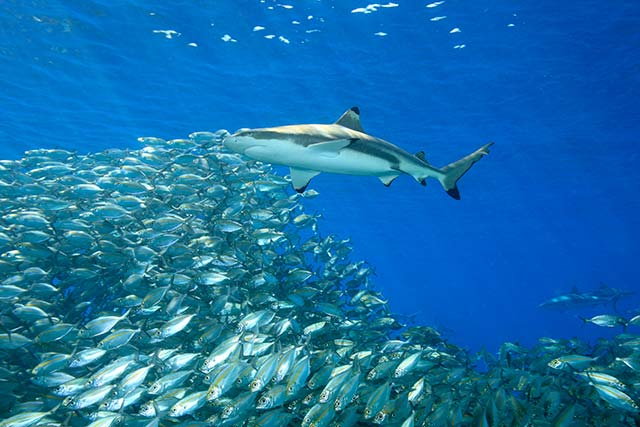
"Diving off the coast of New Britain, this reef has something for everyone who likes reef diving. A wall, large sponges, anenomes/anenome fish, unicorn fish, plenty of cleaning stations, sharks in the large variety, blind shrimp and gobies, soft coral and a plethora of reef usuals for PNG."
Jerry Hamberg
"Pristine reef with lots to see. "
Barbara J. Kuecken, October 2018
"Going only 30-50 feet you'll see some of the most beautiful sites ever seen under water."
Tim Clowers
"Resident sharks, clams, anenomes,cuttle fish, ocotpus, eels, stone fish, scorpion fish, hard and sort corals, feather stars, anthias and PNG reef usuals like pyramids, triggers, batfish, angels, ect.
"
Jerry Hamberg
"Rabaul has a
reputation for wrecks, particularly WW2 wrecks. Well, I just wanted to
let people know that I have recently come back from a trip to Rabaul and
found it a little disappointing. To put this into context, whilst I have
not dived Truk, I have dived a fair few of the WW2 wrecks in the Solomon
Islands and Coron, Philippines. Back to Rabaul: because the volcano is
still smoking, it is dropping ash into the harbour which is close by, so
many of the wrecks are quite silty and vis can be poor. In addition,
because of seismic activity, it is inadvisable to penetrate many of the
wrecks in the harbour. This is a great shame, because there are many
good sized wrecks around. My vote for best wreck goes to the Manko Maru,
followed by the Italy Maru, both of which are a short boat ride in the
harbour. Outside the harbour, George's wreck was not bad either. Hope
this helps divers thinking about their next wreck diving foray.
Iona Hill
"Amid the rubble and debris of the last
century, an odd assortment of critters has made their
home. This is the most easily accessible muck dive in
the country. Manta shrimp poke their heads tentatively from behind
the rocks. Eels of every variety can be found, hiding
in holes or creeping along the silty bottom. A
colourful mixed bag of nudibranchs will keep muck
divers delighted for hours.
"
Rebecca Byfield (see Rebecca's full article below)
"At Veales Reef, the weird and wonderful hammerhead sharks
put on an impressive performance in perfect visibility.
Veales is home to large schools of white-tip and
black-tip reef sharks, huge pelagic fish and colourful
reef fish swimming amongst the beautiful coral formations.
If you are lucky you may see the turtles as they glide
gracefully past.
"
Rebecca Byfield (see Rebecca's full article below)
Cyclone Island was formed during a cyclone in 1972. It
has a number of good sheltered dive sites that are
perfect for snorkellers. Here divers can find the rare
Rhinopias fish or search for the kaleidoscope of
nudibranchs that make their home amongst the corals of
the reef.
"
Rebecca Byfield (see Rebecca's full article below)
Cyclone Reef has a stunning wall, where
divers can hang suspended above the ocean floor 1km below.
Hammerhead sharks have also been known to visit
Cyclone Reef.
"
Rebecca Byfield (see Rebecca's full article below)
is undoubtedly Tufi's best dive site. Due to
strong ocean currents, Mulloway's comes alive with a wide
variety of pelagic fish, reef sharks, hammerheads and
rays that feed on the rich plankton.
"
Rebecca Byfield (see Rebecca's full article below)
Papua New Guinea's most spectacular WWII wreck - the
Jacob is easily accessible from Tufi Dive Resort.
The Jacob was a Dutch merchant ship which was sunk by
the Japanese during the war. It now lies upright
sloping from 45 metres to 60 metres and is accessible
only by experienced deep divers.
"
Rebecca Byfield (see Rebecca's full article below)
The Blackjack is another popular wreck dive accessible
from Tufi, and the two wrecks are often done together.
"
Rebecca Byfield (see Rebecca's full article below)
This article was contributed by By Rebecca Byfield, Freelance Journalist, bec@datec.net.pg
The twin-otter plane flew over the resort, dipping its wing low over crystal clear waters dotted with a plethora of reefs. Volcanic fiords finger their way out into the aqua blue waters of the Solomon Sea.
Perched atop a cliff top, watching over the stunning scenery far below, is Tufi Dive Resort, one of Papua New Guinea's best kept secrets.
Our first dive began at what is affectionately named House Reef. Amid the rubble and debris of the last century, an odd assortment of critters has made their home. This is the most easily accessible muck dive in the country.
Manta shrimp poke their heads tentatively from behind the rocks. Eels of every variety can be found, hiding in holes or creeping along the silty bottom. A colourful mixed bag of nudibranchs will keep muck divers delighted for hours.
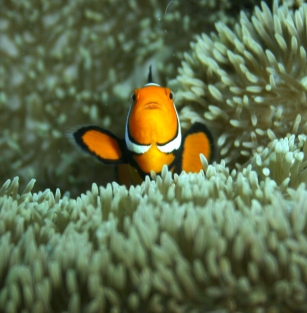
Photo copyright Rod Byfield
Anemone fish, pipefish, sea horses, gobies and fish of every colour and variation swim and play in the murky shallows. Down deeper, at around 40 metres, are the remnants of two WWII PT boats. The 50 calibre machine gun and two live torpedos are still pretty much intact. Divers will also find an old Land Rover, parked upright in about 30 metres of water.
At night, the wharf tenants change over and the House Reef comes alive yet again. Lobsters and crabs walk freely along the ground while octopus dart through the waters in a bold, night time dance of ever changing colour.
During the Mandarin Fish mating season, you will have a perfect, front row seat straight off the wharf.
"It was fantastic seeing the Mandarin Fish mating, although I could't help feeling like a voyeur, peeking in on something private,"
said Patricia, a guest from the UK.
![By Steve Childs [CC-BY-2.0], Mandarin Fish](../indonesia/mandarin-fish.jpg)
Photo credit Steve Childs CC BY 2.0, Mandarin Fish
On the outer reef of Tufi is a collection of stunning reef dives.
At Veales Reef, the weird and wonderful hammerhead sharks put on an impressive performance in perfect visibility. Veales is home to large schools of white-tip and black-tip reef sharks, huge pelagic fish and colourful reef fish swimming amongst the beautiful coral formations. If you are lucky you may see the turtles as they glide gracefully past.
Cyclone Island was formed during a cyclone in 1972. It has a number of good sheltered dive sites that are perfect for snorkellers. Here divers can find the rare Rhinopias fish or search for the kaleidoscope of nudibranchs that make their home amongst the corals of the reef. Cyclone Reef also has a stunning wall, where divers can hang suspended above the ocean floor 1km below. Hammerhead sharks have also been known to visit Cyclone Reef.
Mulloway's is undoubtedly Tufi's best dive site. Due to strong ocean currents, Mulloway's comes alive with a wide variety of pelagic fish, reef sharks, hammerheads and rays that feed on the rich plankton.
"I couldn't believe my eyes," said one of the visitors from the US.
"Just below us was a large shark totally covered in sucker fish. I've never seen anything like it."
Papua New Guinea's most spectacular WWII wrecks - the Jacob is easily accessible from Tufi Dive Resort. The Jacob was a Dutch merchant ship which was sunk by the Japanese during the war. It now lies upright sloping from 45 metres to 60 metres and is accessible only by experienced deep divers.
The Blackjack is another popular wreck dive accessible from Tufi, and the two wrecks are often done together.
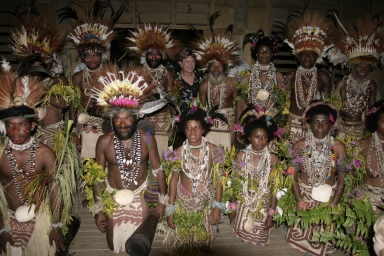
"The Locals" by Rob Byfield
Tufi is on the Southeast coast of Papua New Guinea, below Lae but just above Alotau and east of Port Moresby. It is only accessible by sea and air. Rebecca was diving at the Tufi Dive Resort: PO Box 1845, Port Moresby, Papua New Guinea. Tel: 675 329 6000, Fax: 675 329 6001, E-mail: info@tufidive.com
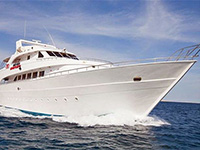
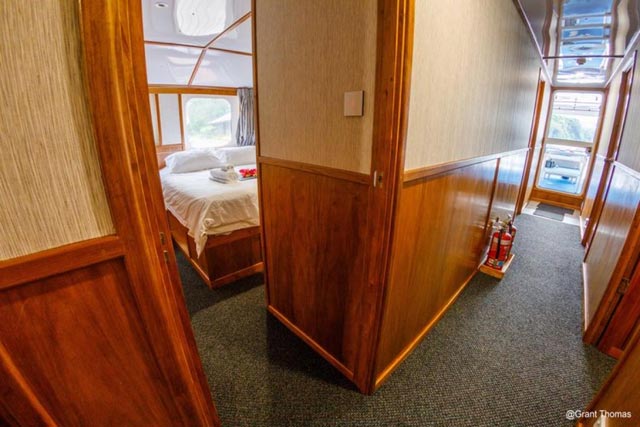
Seven air-conditioned en-suite cabins, catering to a maximum of 12 guests. With underwater photographers needs in mind, the MV FeBrina Liveaboard was designed with a camera table on the dive deck and shelves set up with 110V and 220V outlets for recharging batteries. Three decks on board give plenty of room to relax in-between dives. Home port is the Walindi Plantation Resort.
Book Febrina Liveaboard - pay later…

PO Box 1845
Port Moresby
Papua New Guinea
Tel: +675 7109 6241
Fax: +67 5323 1303
E-mail: info@tufidive.com
Tucked away, only accessible by boat, overlooking the clear protected waters of Milne Bay.
Alotau
Milne Bay Province
Papua New Guinea
Provides PADI services to guests at the Madang Resort, Kalibobo Village and aboard the Kalibobo Spirit. NDA operate the Aqua Venture, the Madang Reef Explorer and several smaller vessels for diving in Madang and from zodiacs aboard the Kalibobo Spirit.
E-mail: nda@mtspng.com
PO Box 489
Kokopo
ENBP
Papua New Guinea
Established in 1983, an intimate dive resort situated on the shores of Kimbe Bay on the island of New Britain.
Kimbe/Talasea Road
Kimbe
WNBP
Papua New Guinea
Tel: +675 7234 8460
resort@walindifebrina.com
New Ireland is a large island northeast of the island of New Britain.
PO Box 580
Kavieng
New Ireland Province
631 Papua New Guinea
Tel: +675 7234 5834
info@lissenung.com
Papua New Guinea Liveaboards - Compare prices online. Book now & pay later.
Send us your comments on this article, diving in Papua New Guinea or anything else on the SCUBA Travel site.