

Photo copyright Tim Nicholson.
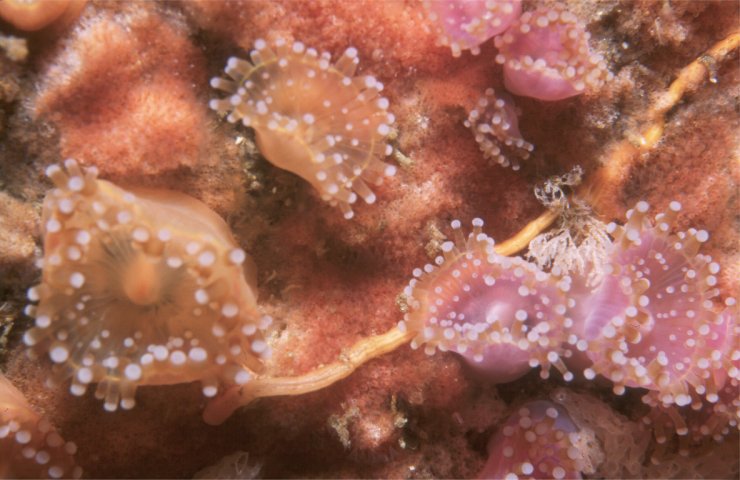
Corynactis viridis, Jewel Anemone
Taken with a macro lens off St Kilda, Scotland.
When a myriad of colour patches cover a rock it is generally because of jewel anemones. The reason for the large patches is their capacity for asexual reproduction. The adult anemone splits itself longitudinally into two. When repeated large colonies form. The jewel anemones prefer fast flowing water and are often found with plumose anemones. A jewel anemone has around one hundred tentacles but in the photo the tentacles are retracted. The jewel anemone is up to 2.5 cm across and resembles a coral but lacks a skeleton.
Sea anemones feed on invertebrates. The prey is paralysed by nematocysts, caught by the tentacles and carried to the mouth in the centre of the tentacles. Water pressure inside the body maintains the anemone's shape and provides a base for muscle action.
Further Reading
Great British Marine Animals, by Paul Naylor, Deltor (2011)
The Underwater Photographer: Digital and Traditional Techniques, by by Martin Edge, Paperback, 536 pages (2009)
